Showing posts with label nonfiction. Show all posts

Monday, June 24, 2024

The Ride of Her Life: The True Story of a Woman, Her Horse, and Their Last-Chance Journey Across America

by Elizabeth Letts

I thoroughly enjoyed reading this book.  As it opens, 62-year-old Annie Wilkins goes to the hospital with a bout of pneumonia.  While there recovering, her Uncle Waldo is sent to a care home where he dies.  When Annie returns home the doctor tells her to live restfully.  She has a farm to take care of, now without the help of her uncle, and she doesn’t have enough money to pay taxes on the farm to keep it.  She decides to buy a horse and ride to California to fulfill the dream her mother had of visiting the state.  (And she chooses an interesting way to earn money for the horse.)  She buys Tarzan, a Morgan horse, packs up her possessions—at least what she believes she’ll need on the trip—and with her little dog, Dépêche-toi, they set off from Minot, Maine, in November, 1954. 

The book recounts Annie's travels, negotiating highways with her horse, her interactions with those she meets along the way including those who give her shelter and help, and incorporates a bit of history of some of the places she stayed.  Through the book we get an idea of what it was like living in America in the mid-1950s.  One of the themes Letts brings up several times is the change in outlook from the view of a safe America to one of uncertainty about strangers vs. potential acquaintances/neighbors/friends that was happening at that time in America.  (See quotes p. 55 and p. 9.)

Also, books and movie mentioned:  The Last of the Saddle Tramps by Annie Wilkins; November Grass by Judy Van Der Veer; and the movie, “Saddle Tramp.”

Quotes
“The unexpected could always be a shock, but sometimes it was the expected, the predictable, the resigned acceptance of whatever bad thing was coming your way that could end up dragging you down.”    p. 34  ¶1

“The feeling of deep connection was becoming less common in this postwar period, which, for many Americans, was a time of increasing xenophobia.  In 1952, Congress has passed the McCarran-Walter Act, reinforcing racially based quotas introduced in the 1920s, in part due to anti-Semitic bigotry and fears of communism.  Senator Joseph McCarthy had whipped up the fear of Communist infiltrators with his inflammatory rhetoric.  ‘Man the watchtowers of the nation,’ he scolded.  ‘Be vigilant day and night.’  Being vigilant was generally the opposite of being neighborly.  In a world of connection, bonds of friendship and kinship made every stranger a potential acquaintance.  The world of vigilance suggested the opposite:  every stranger might bring danger.”    p. 55  ¶1

Annie’s favorite poem, attributed to Walter Wintle:
      If you think you are beaten, you are;
      If you think you dare not, you don’t.
      If you’d like to win, but you think you can’t,
      It’s almost a cinch you won’t.
    
      If you think you’ll lose, you’ve lost,
      For out in the world we find
      Success begins with a fellow’s will—
      And it’s all in the state of mind.    p. 91

“And isn’t this just how life is anyway?  You could plan, but you couldn’t control much, except your own two feet and which way you chose to point them....  On they trudged, hoping that around some bend they would see a welcoming light.
  “And isn’t that what hope is?  Not a wish, not a specific thing that you pray will be delivered to you, but merely an expectation that whatever dark, sleety side of the road you might find yourself on will not last forever.”    p. 117-118

“The coming of television and mass media to America had an unexpected effect:  it was bringing stories of crime from all over America right to people’s doorsteps.”    p. 119  ¶3

“In the words of Henry Ward Beecher, ‘The difference between perseverance and obstinacy is that one often comes from a strong will, and the other from a strong won’t.’”   p. 146  ¶5

“Because that’s the thing about the future.  You can’t get there by imagining.  You can only get there one step at a time, and the hardest part is taking that first step.”    p. 213  ¶2

Annie crossed the mighty mountains and wondered if they were no bigger than molehills.  “Sometimes life is just like that, Annie thought.  You can be so worried about the challenge in front of you that you fail to realize that you’ve been chipping away at it all along.”    p. 222  ¶2

Learn more about and see photos of Annie Wilkins here.

nm

Wednesday, June 5, 2024

Penguin the Magpie. The Odd Little Bird Who Saved a Family

by Cameron Bloom and Bradley Trevor Grieve

This was a dual story: the author’s wife fell off a second floor balcony, cracked her skull in two places, and broke her spine, thereby becoming paralyzed from the arms down. Soon after that, their sons found a baby magpie and the family chose to nurse it back to health.

Many, many wonderful photos accompanied by words.  At the end is an essay by the author and one by his wife, who writes directly to others who have dealt with a spinal cord injury.

Quotes

“You don’t have to be superhuman to survive the bad times and you can’t always be at your best.   But even when things look their worst, you can still feel positive about the future.  Being optimistic is simply a choice made possible by being creative and proactive.  The means to achieving the breakthrough you need may be a lot closer than you think."     p. 146

“A happy ending begins with having faith in your own story, and looking for ways to create joy for yourself and others.  Time and time again Penguin showed us what a difference it can make just by giving our family and friends a reason to smile when they see us.”      p. 149

“Most importantly, Penguin taught us that helping others feel better is the easiest and best way to help yourself feel better."      p. 162

nm

Saturday, May 25, 2024

Remember. The Science of Memory and the Art of Forgetting

by Lisa Genova

Excellent!  I love this book.  Genova, a neuro-scientist, seems to have written this book for the layman, the person concerned about forgetting/not remembering and wondering if it’s normal and natural or a sign of Alzheimer’s.

These are just some notes, and then some specific quotes.

You must pay attention to create a memory.  If you were there and something happened but your attention was elsewhere, no memory was created to remember.  In the moment most things are lost unless something memorable happens.  (“...We learn to ignore what is familiar and of no consequence.  We can’t remember what we ignore.  Remembering requires that we give the thing to be remembered our attention.”  p. 80  ¶2)

The hippocampus is where new and long term memories are stored.  The prefrontal cortex is where present moment is remembered.

Working memory - whatever is held in your consciousness right now in the present moment.  It’s short-lived, holding space in the prefrontal cortex for sights, sounds, smells, tastes, and language.
  
Declarative memories = things I know.  Sometimes must work to recall them.

3 kinds of long-term memory
- semantic memory - for information
- episodic memory - for what happened
- muscle memory - for how to do things (ride a bike, play a piece on the piano, etc.)
Muscle memory (brain not muscle) –- a sequence of events bound together by the basal ganglia -- is the ability to perform a previously learned skill

Semantic memory -- what you know not attached to any person, what or where, or any specific experience; information; the history of you remembered by you (beginning on p. 78)
Episodic memory - attached to what and where:  personal and always about the past

Memory - consolidating and retrieving what you’ve learned.  Quiz yourself about what you learn (semantic memories)..

Quotes

“Regular use of these tools — repetition, spaced learning, self-testing, meaning, and visual and spatial imagery — will no doubt strengthen your semantic memory.”    p. 75  ¶1

“Why do we retain so few memories for what happened when we were young?  The development of language in our brains corresponds with our ability to consolidate, store, and retrieve episodic memories.  We need the anatomical structures and circuitry of language to tell the story of what happened, to organize the details of our experiences into a coherent narrative that can then be revisited and shared later.  So as adults, we only have access to memories of what happened when we owned the language skills to describe them.”    p. 86-87

“Your episodic memories are chock-full of distortions, additions, omissions, elaborations, confabulations, and other errors.  Basically, your memories for what happened are wrong...."  (p. 99  ¶1)

“For every step in memory processing—encoding, consolidation, storage, and retrieval—your memory for what happened is vulnerable to editing and inaccuracies.  To begin with, we can only introduce into the memory creation process what we notice and pay attention to in the first place.  Since we can’t notice everything in every moment that unfolds before us, we only encode and later remember certain slices of what happened.  These slices will contain only the details that were seduced by our biases and captured our interest.  So my memory for what happened last Christmas morning will be different from what my son remembers, and neither his memory or mine will contain the full picture—the whole truth, so to speak.  From the get-go our episodic memories are incomplete....
  “Nascent memories are highly susceptible to influence and creative editing, especially during the period—hours, days, and longer—when these memories are being consolidated, before they’re committed to long-term memory.
  “In the process of consolidating an episodic memory, your brain is like a sticky-fingered, madcap chef.  While it stirs together the ingredients of what you noticed for any particular memory, the recipe can change, often dramatically, with additions and subtractions supplied by imagination, opinion, or assumptions.  The recipe can also be warped by a dream, something you read or heard, a movie, a photograph, an association, your emotional state, someone else’s memory, or even mere suggestion.
  “And every time we retrieve a stored memory for what happened, it’s highly likely that we change the memory....” [Much more detail in the book.]    p. 99-101

“Prospective memory is your memory for what you need to do later.  This kind of memory is a bit like mental time travel.  You’re creating an intention for your future you.  This is your brain’s to-do list, a memory to be recalled at a future time and place.  And it is fraught with forgetting.  In fact, prospective memory is so poorly supported by our neural circuitry and so steeped in failure, it can almost be thought of as a kind of forgetting rather than a kind of memory.”    p. 132  1

To help remember, create a cue – time-based, event-based
  “This kind of memory is highly susceptible to failure.”    p. 133  ¶2

“When it comes to saving your memories, repetition is a mighty warrior in the battle against time.
  “But maybe you want to forget something....  Stop repeating the story of what happened.  Stop going over the details with your friends and in your thoughts.  Don’t overlearn the experience.  If you can find the discipline to leave those memories alone, they will eventually fade....  The emotional elements of that memory can gradually decay if left alone.  It is through the erosion of memory that time heals all wounds.”    p. 151  ¶1-2

“We tend to vilify forgetting.  We cast it as the bad guy in the epic battle against everyone’s favorite hero, Remembering.  But forgetting isn’t always a regrettable sign of aging, pathological symptom of dementia, a shameful failure, a maladaptive problem to solve, or even accidental.  Remembering today the details of what happened yesterday isn’t always beneficial.  Sometimes, we want to forget what we know.
  “We also tend to think of forgetting as our default setting.  Unless you actively do something remember some piece of information, your brain will automatically forget it.  Easily....  We forget without trying... because we didn’t pay enough attention... because we didn’t create strong enough relevant cues....  Forgetting can also be artful—active, deliberate, motivated, targeted, and desirable.”    p. 156  ¶1-2

About active ways of forgetting (motivated forgetting)    beginning p. 159, p. 163
  “So while we all want to an amazing memory, we can’t put all the onus and credit on remembering.  An optimally function memory system involves a finely orchestrated balancing act between data storage and data disposal: remembering and forgetting.  When performing optimally, memory doesn’t remember everything.  It retains what is meaningful and useful, and it discards what isn’t.  It keeps the signal and purges the noise.  Our ability to forget is likely to be just as vital as is our ability to remember.”    p. 163  ¶last

“Using the strategies and insights you’ve read about in this book—paying attention, decreasing distractors, rehearsing, self-testing, creating meaning, using visual and spatial imagery, keep a diary—will improve memory at any age.  They may have a less powerful effect on your memory performance at seventy than they would if you were thirty, but these methods still work.”    p. 172-173

 “Memory creation requires attention.  Paying attention is the number one thing you can do to improve your memory at any age, and a lack of attention will impair it.  Every time.....  What else boosts or blocks memory formation and retrieval?  Often, our ability remember depends on context.”    p. 189  ¶1

“You’ll be better able to recall ... information if you’re in the same state as you were [hungry, hot, tired, stressed, thirsty, etc.] when you learned it.”    p. 194  ¶2

About sleep and memory, beginning p. 207
  Sleep is not doing nothing, it’s a biologically busy state that’s vital to health. 
  "Sleeping also hits the save button on ... newly encoded memories.  It saves memories in two steps:  First, the unique pattern of neural activity that occurred in your brain when you were experiencing, learning, and even rehearsing something while awake is reactivated during sleep.  This neural replay is thought to facilitate the linking of these connections, cementing them into a single memory.  In fact, the amount of replay that occurs during the consolidation process while you snooze correlates with the amount of memory you’ll be able to recall after you wake up.”    p. 209  ¶1
  Lack of sleep interferes with consolidation of memories.
  Naps can help.
  “A growing body of evidence suggests that sleep is critical for reducing your risk of Alzheimer’s disease....  Most neuroscientists believe that Alzheimer’s is caused by an accumulation of amyloid plaques.  Normally, amyloid is cleared away and metabolized by glial cells, the janitors of your brain.  As a group, these cells form your brain’s sewage and sanitation department.  During deep sleep, your glial cells flush away any metabolic debris that has accumulated in your synapses while you were in the business of being awake.  Deep sleep is like a power cleanse for your brain.  And one of the most important things that is cleared away during your nightly slumber is amyloid.
  With not enough deep sleep “the glial cells won’t have enough time to finish cleaning your brain, and you will wake up in the morning with amyloid left over in your synapses from yesterday.  An amyloid hangover.”    p. 213
  More, more, more in this chapter.  Read it again.  In fact, read the whole book again!

My only complaint of this book is that there are no notes to support her statements.

nm

Wednesday, May 15, 2024

The Dressmakers of Auschwitz: The True Story of the Women Who Sewed to Survive

by Lucy Adlington

Excellent!  In some ways it was hard to read (as in sorrowful) but so worth it.  The author introduces the reader to a number of young, female seamstresses as they grow into adulthood in Slovakia, Czechoslovakia, Germany, and France and then find themselves prisoners in the Auschwitz-Birkenau concentration camp where they were eventually selected to become seamstresses in a salon for the wives of Nazi leaders.  (I can’t imagine having to do a work I love for people who treat me like vermin.) 

Without being too graphic the author presents the situation of the captives and takes us into the concentration camp, showing the reader several areas of the camp including Kanada, warehouses of looted goods from captured Jews.  It was almost a behind-the-scenes look at some aspects of Auschwitz.

It was interesting to learn how friendships formed and how some prisoners supported each other, creating solidarity.

The book is based on research and interviews with 98-year-old Bracha Berkovic Kohút, and daughters, granddaughters, and other family members of those who were in Auschwitz.

Early in the book the author discussed how fashion can create unity (and to some extent, pride) in a group of people, something I had never thought about.  Think Boy Scout uniforms to military uniforms and even national folk costumes.  Fashion can also create divisiveness.

I came away with two lessons/reminders:
  • First, we are all human beings.  We should not let the color of skin, the nationality, the religion of an other individual become a reason to reject, taunt, bully, or in any way harm another person, either physically or emotionally.
  • Second, resistance can be manifest in a variety of ways. 

More about the book at https://www.timesofisrael.com/sewing-for-survival-the-last-of-auschwitzs-forgotten-dressmakers-dies/

This is a video of the author, Lucy Adlington  who is a fashion historian.  On the video she talks about her research, and how clothing was important to the Germans.  She also shares some background information that isn't in the book.


It's a fabulous book and you will probably came way grateful for your own circumstances and amazed at the resilience of the dressmakers of Auschwitz. 

nm


Friday, May 3, 2024

Home

by Isabelle Simler, translated by Vineet Lal

This is a beautiful picture book, one appropriate for both children and adults, with bright illustrations of homes of various animals, birds, and insects.  I was familiar with some of the animals but others were new to me:  the comet moth, European fan worm, hummingbird, satin bowerbird, case-making caddisfly, diving bell spider, elf owl, Eurasian harvest mouse, red ovenbirds, and many others. 

The illustrations for each animal fills two pages.  They are less illustrations and more drawings.  The colors are rich, deep, and brights, as appropriate for each animal.  Accompanying the drawings are brief poem-like descriptions of the animals and their homes.  At the end of the book is a paragraph about each animal, its locality, and its home. 

I can imagine this book being a good jumping off point for further research into the animals, especially for upper elementary students.

Truly, a beautiful book.

nm


Monday, March 11, 2024

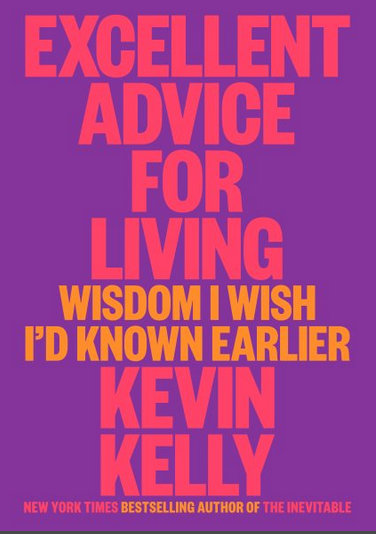
Excellent Advice for Living:
Wisdom I Wish I'd Known Earlier

by Kevin Kelly

The author said he wanted to collect these for the benefit of his children.  In my opinion, that's a great idea.  My father was a wise man and I wish he'd written down some of his best bits of wisdom.  I remember a few things he used to say, but not many.

These were short insights with one, two, or three entries per page, each a sentence or several long.  I didn't race through this book but took a few minutes, or longer, to think about each bit of advice.   

I've included a few of his insights, below.  They are ones that I needed to hear for my own circumstances.

“Collecting things benefits you only I you display your collection prominently and share it in joy with others.  The opposite of this is hoarding.”’    p. 9

“If you are looking for something in your house and you finally find it, when you’re done with it, don’t put it back where you found it.  Put it back where you first looked for it.”    p. 13

“A great way to understand yourself is to seriously reflect on everything you find irritating in others.”    p. 14

“If you are the smartest person in the room, you are in the wrong room.  Hang out with, and learn from, people smarter than yourself.  Even better, find smart people who will disagree with you.”    p. 19

“The purpose of a habit is to remove that action from self-negotiation.  You no longer expend energy deciding whether to do it.  You just do it.  Good habits can range from telling the truth to flossing.”    p. 23

“Promptness is a sign of respect.”     p. 24

“Nothing elevates a person higher than taking responsibility for their mistakes.  If you mess up, fess up.  It’s astounding how powerful this ownership is.”    p. 30

“If you are not falling down occasionally, you are just coasting.’    p. 32

“Learn how to tie a bowline knot.  Practice in the dark.  With one hand.  For the rest of your life you’ll use this knot more times than you would ever believe.”    p. 60

“All the greatest prizes in life in wealth, relationships, or knowledge come from the magic of compounding interest, by amplifying small steady gains.  All you need for abundance is to keep adding 1% more than you subtract on a regular basis.”    p. 85

“When you have good news and bad news, give the bad news first, because we remember how things end more than how they begin.  So elevate the ending with good news.”    p. 115

“Denying or deflecting a compliment is rude.  Accept it with thanks, even if you believe it is not deserved.”    p. 126

“A wise man said:  Before you speak, let your words pass through three gates.  At the first gate, ask yourself, ‘Is it true?’  At the second gate ask, ‘Is it necessary?’  At the third gate ask, ‘Is it kind?’”    p. 135

“Remember that repair tasks take 3 times longer than expected, even when you expect them to take 3 times longer.”    p. 152

“You will thrive more—and so will others—when you promote what you love rather than bash what you hate.  Life is short; focus on the good stuff.”    p. 166

“Anger is not the proper response to anger.  When you see someone angry you are seeing their pain.  Compassion is the proper response to anger.”    p. 177

“Trust is earned in drops and lost in buckets.  Unwavering honesty will help seal in trust.”    p. 193

“Your best teacher is your last mistake.    p. 195

“Instead of asking your child what they learned today, ask them who they helped today.”    p. 196

“To succeed once, focus on the outcome; to keep succeeding, focus on the process that makes the outcome.”     p. 198

“The natural state of all possessions is to need repair and maintenance.  What you own will eventually own you.  Choose selectively.”    p. 204

“Right now, no matter your age, these are your golden years.  The good stuff will yield golden memories and the bad stuff will yield golden lessons.”    p. 207

“See that old person taking forever in line?  That is the future you.  Have patience.’    p. 208

Kevin Kelly's blog is "The Technium", at https://kk.org/thetechnium/

nm


Monday, January 15, 2024

The Perfectionist's Guide to Losing Control:
A Path to Peace and Power

by Katherine Morgan Schafler

I read parts of this book and learned some things about perfectionists however, when the profanity appeared, my esteem for the author decreased immensely.  I suppose I’m old school:  I expect professionals to write and speak and act like professionals and adhere to a higher standard.  Yes, I learned some things about perfectionists and perfectionism by browsing through the book, but it didn’t hold my interest enough to read every page. 

One thing I did appreciate was the author's stance that perfectionism is a not a flaw [as most people I know think] or a mental illness to be dealt with but a “fundamental component of who [a person is] (p. xv).”

She also suggested that there are different kinds of perfectionists/perfectionism.  Not all is being perfect and doing everything perfectly.  Sometimes it's about the motivation to keep getting better.

Quotes
  “Ambition is not a universal trait.  Some people are not interested in continually pushing themselves towards their highest potential or chasing an ideal.  They may not ever even think about it....
  “Perfectionists have trouble relating to people who don’t hold a strong impulse towards perfectionism, and vice versa.
  "Unlike perfectionists, some people can enjoy daydreaming about ideals without experiencing attendant pressure to work towards actualizing them.  Feeling their potential press upon them from the inside out daily and acutely is not their experience, as it is for perfectionists.  They don’t encounter a chronic restlessness to achieve, excel, and advance....
  “Some people like to work as little as possible, watch some TV, enjoy their hobbies, chill by themselves or with others, and do the same thing again tomorrow.  Perfectionists wonder if those people might be depressed in some way:  ‘If you just applied yourself more, you could turn this hobby into a real business.  Don’t you want to turn off the TV?  If you woke up one hour earlier, you could clear your inbox, learn French in a year, have a garage cleaned out by spring.  Are you okay?  Do you need to talk?’
  “Similarly, non-perfectionists look to perfectionists with some degree of confusion and judgment-laced concern:  “Why do you always have to be taking on another challenge?  Can’t you just sit still?  Can’t you just relax?  Are you okay?  Do you need to talk’?
  “Neither is better or worse; they’re different.” 
pp. 30-31  

--nm