by Robert MacFarlane and Jackie Morris
Oh my goodness, what a beauty of a book! Just exquisite. It is filled with watercolor
paintings of animals, birds, nature. Each painting is accompanied by a delightful, insightful poem. Some are
a single page, others several pages long.
There are poems for fox, moth, daisy, jackdaw, jay, gorse, swifts,
goldfinch, oak, snow hare, barn owl, heartwood, curlew, egret, grey
seal, gannet, thrift, woodpecker, beech, swallow, and silver birch. I
almost think I learned more about the character and attributes of these
animals and plants from the poems than from reading descriptions in a science book or online. I
loved, loved, loved jackdaw, thrift, and woodpecker. All were great,
though.
Here's a video showing the pages, but the beauty of the books is created by both images and words (another version of images in the hands of Robert MacFarlane).
Best to see and read it in person, holding it in your own hands!
nm
Monday, May 13, 2024
Wednesday, May 8, 2024
The Last Bookshop in London. A Novel of World War II
by Madeline Martin
Grace and her friend Viv have been best friends since they were children and had always dreamed of moving to London. When they arrive there as young adults in 1939, it is nothing like they imagined or expected. They board with Mrs. Weatherford, Grace’s deceased mother’s best friend, at a discount.
Viv has a (forged) letter of recommendation. Grace has none, even though she’d worked for years at her uncle’s hardware store. Mrs. W. to the rescue: she has arranged employment for Grace at a dusty, cluttered, disorganized bookshop. Grace doesn’t enjoy reading and is not excited about this work. When she arrives the first day, Mr. Evans, the owner, immediately dismisses her. Mrs. W. will have none of it and returns to visit Mr. Evans who, the next day, grudgingly acknowledges Grace. Grace has a good work ethic and a knack for organization. She begins to put the shop in order. And then there’s the war, the Blitz, and Grace becomes a warden for the ARP (Air Raid Protection).
This was a great book for putting the reader in the setting of WWII in England with all its limitations and restrictions on citizens—rations, black-out curtains, getting around outside at night without lights, going on little sleep because of the bombings and sleeping in shelters, etc. And then there was all the dust and debris and the dangers of moving in an environment that was tumbling down. I realized that while the Germans were trying to obliterate England in order to conquer it, one of the other outcomes (Was it an intentional strategy?) was wearing the people down. How did the the British survive on so little sleep, with such limited food? The British are a resilient people!
I keep saying I’m done with WWII books, but I’m glad I read this one.
Quotes
George speaking: “‘Reading is . . . . It’s going somewhere without ever taking a train or ship, an unveiling of new, incredible worlds. It’s living a life you weren’t born into and a chance to see everything colored by someone else’s perspective. It’s learning without having to face consequences of failures, and how best to succeed.” p. 73 ¶5
“As much as she loved reading the story, no one had prepared her for the end being so bittersweet. No one told her finishing the book would leave her so bereft. It was as though she’d said goodby for the last time to a close friend.” p. 115-116
“There was a special scent to paper and ink, indescribable and unknown to anyone but a true reader. She brought the book to her face, closed her eyes and breathe in that wonderful smell.” p. 195, top
nm
Saturday, May 4, 2024
Mrs. Quinn's Rise to Fame
by Olivia Ford
At the age of 77, Mrs. Jennifer Quinn decides she’d like to enter the Britain Bakes contest. After all, she’s baked most of her life. But she keeps her desire and the application process a secret from her husband, Bernard, thinking she wouldn’t get chosen and feeling uncertain about his response. This leads to his suspicions that she has some medical problems. There is one other secret she’s kept from him for fear of destroying their solid and loving marriage.
I enjoyed reading this book but the second secret seemed to me an odd addition to the story.
"It’s strange, she thought, how recipes outlive the people that wrote them and yet they almost bring a part of that person back to life, as if a tiny piece of their soul lives in those instructions.” p. 3 ¶ last
“Life could take away opportunities, but never your imagination.” p 95 ¶2
“She studied the photograph of all that Ann and Fred had made [their grandchildren]. Although they were no older than five or six, it struck her that they were little time capsules of all those who came before them, mirrors of their ancestors who had lived through wars and fallen in love and, by a stroke of luck, survived. That red hair, an aptitude for math, was in fact an age-old gift from someone that they had never met, but without whom they would not exist.” p. 99, ¶1
“She would never be able to comprehend the strange borrowed time that you experience before bad news hits; the minutes, hours, sometimes days where you reside in a bubble of ignorance, a place where small things still matter, before it is pierced by the needle of perspective.” p. 216 ¶5
nm
Friday, May 3, 2024
Home
by Isabelle Simler, translated by Vineet Lal
This is a beautiful picture book, one appropriate for both children and adults, with bright illustrations of homes of various animals, birds, and insects. I was familiar with some of the animals but others were new to me: the comet moth, European fan worm, hummingbird, satin bowerbird, case-making caddisfly, diving bell spider, elf owl, Eurasian harvest mouse, red ovenbirds, and many others.
The illustrations for each animal fills two pages. They are less illustrations and more drawings. The colors are rich, deep, and brights, as appropriate for each animal. Accompanying the drawings are brief poem-like descriptions of the animals and their homes. At the end of the book is a paragraph about each animal, its locality, and its home.
I can imagine this book being a good jumping off point for further research into the animals, especially for upper elementary students.
Truly, a beautiful book.
nm
Wednesday, March 20, 2024
The Beekeeper's Promise
by Fiona Valpy
We meet Eliane in 2017 when she is tending bees. She is in her 90s.
We meet Abi next, also in 2017, as she tells us her story. We see that Abi is emotionally lost. We later learn that she was in an abusive marriage and in a horrible car accident and is just now beginning to heal. She has come to France with a friend to attend a yoga retreat and ends up taking on employment at the chateau where Eliane lived during World War II.
We learn Eliane’s story, beginning in 1938 through a narrator. She was a keeper of bees, a tender of gardens, and quietly did what she could to support’s France’s resistance effort. The story goes through the end of World War II.
As Abi learns of Eliane’s story, she gathers strength and courage.
This was mostly clean—no language or sex, but there was a scene briefly telling the results of Nazi violence.
I'm not a huge fan of books with dual time-lines and major characters, but I thought the author managed both well in this book.
I keep saying I’m done with WWII stories, and then another falls in my lap, and I learn some other experience from the war, of the courage and strength of those who lived through it and see how they can impact others’ and my own life. I’m definitely glad I read this one.
Quotes
Abi: “That’ll teach me to be spontaneous, I think, as I trudge along the hot tarmac of the road. Nothing good ever comes of it.” p. 6 ¶1
Lisette, Eliane’s mother, before helping several Jewish people past German checkpoints:
“She put her hand gently on [her husband’s] and smiled at him, although there was a sadness behind the smile. ‘You know, Gustave, my attitude has always been to try to carry on as normal, ignoring the war as much as possible, just concentrating on getting my family and my patients safely through it. But there’s a question I ask myself every day.’ She looked past him, out of the window towards the weir. ‘When do you cross the line? What does it take to reach that point? For your country to be threatened? Your way of life? Your neighbours’ homes? Or you own? For your friends to be in danger? Or your children?’ She turned back to face him. ‘Every one of us has to make that decision for ourselves. Whether we win or lose this war, we will have to live with the consequences of our decisions. I’ve asked myself: “What will be on your conscience when all this is over? What will your decision be when you get to that crossing point?” Well, I’m at that crossing point now. And I’ve made my decision. Just as all of you –‘ she glanced around at Eliane, Yves and Jacques – ‘have done already.’” [I forgot to note the page and paragraph for this quote.]
nm
Monday, March 11, 2024
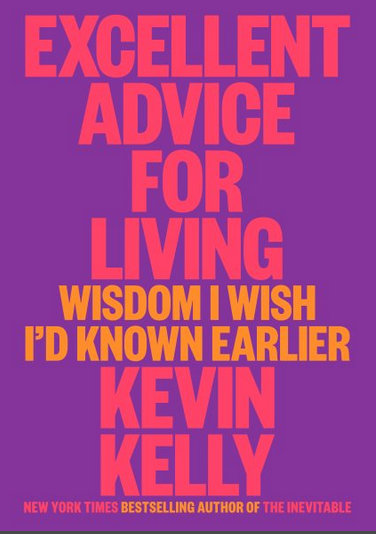
Excellent Advice for Living:
Wisdom I Wish I'd Known Earlier
by Kevin Kelly
The author said he wanted to collect these for the benefit of his children. In my opinion, that's a great idea. My father was a wise man and I wish he'd written down some of his best bits of wisdom. I remember a few things he used to say, but not many.
These were short insights with one, two, or three entries per page, each a sentence or several long. I didn't race through this book but took a few minutes, or longer, to think about each bit of advice.
I've included a few of his insights, below. They are ones that I needed to hear for my own circumstances.
“Collecting things benefits you only I you display your collection prominently and share it in joy with others. The opposite of this is hoarding.”’ p. 9
“If you are looking for something in your house and you finally find it, when you’re done with it, don’t put it back where you found it. Put it back where you first looked for it.” p. 13
“A great way to understand yourself is to seriously reflect on everything you find irritating in others.” p. 14
“If you are the smartest person in the room, you are in the wrong room. Hang out with, and learn from, people smarter than yourself. Even better, find smart people who will disagree with you.” p. 19
“The purpose of a habit is to remove that action from self-negotiation. You no longer expend energy deciding whether to do it. You just do it. Good habits can range from telling the truth to flossing.” p. 23
“Promptness is a sign of respect.” p. 24
“Nothing elevates a person higher than taking responsibility for their mistakes. If you mess up, fess up. It’s astounding how powerful this ownership is.” p. 30
“If you are not falling down occasionally, you are just coasting.’ p. 32
“Learn how to tie a bowline knot. Practice in the dark. With one hand. For the rest of your life you’ll use this knot more times than you would ever believe.” p. 60
“All the greatest prizes in life in wealth, relationships, or knowledge come from the magic of compounding interest, by amplifying small steady gains. All you need for abundance is to keep adding 1% more than you subtract on a regular basis.” p. 85
“When you have good news and bad news, give the bad news first, because we remember how things end more than how they begin. So elevate the ending with good news.” p. 115
“Denying or deflecting a compliment is rude. Accept it with thanks, even if you believe it is not deserved.” p. 126
“A wise man said: Before you speak, let your words pass through three gates. At the first gate, ask yourself, ‘Is it true?’ At the second gate ask, ‘Is it necessary?’ At the third gate ask, ‘Is it kind?’” p. 135
“Remember that repair tasks take 3 times longer than expected, even when you expect them to take 3 times longer.” p. 152
“You will thrive more—and so will others—when you promote what you love rather than bash what you hate. Life is short; focus on the good stuff.” p. 166
“Anger is not the proper response to anger. When you see someone angry you are seeing their pain. Compassion is the proper response to anger.” p. 177
“Trust is earned in drops and lost in buckets. Unwavering honesty will help seal in trust.” p. 193
“Your best teacher is your last mistake. p. 195
“Instead of asking your child what they learned today, ask them who they helped today.” p. 196
“To succeed once, focus on the outcome; to keep succeeding, focus on the process that makes the outcome.” p. 198
“The natural state of all possessions is to need repair and maintenance. What you own will eventually own you. Choose selectively.” p. 204
“Right now, no matter your age, these are your golden years. The good stuff will yield golden memories and the bad stuff will yield golden lessons.” p. 207
“See that old person taking forever in line? That is the future you. Have patience.’ p. 208
Kevin Kelly's blog is "The Technium", at https://kk.org/thetechnium/
nm
Tuesday, March 5, 2024
The World of All Creatures Great and Small:
Welcome to Skeldale House
by James Steen
This was a behind-the-scenes look at the making of this TV program. I liked it a lot! The chapter titles include:
From Jill Clark, the animal trainer:
“No matter how difficult the animal might seem, you’ll always get something out of it. And you can always work around them as long as you know their temperament and basic behavior. It’s a matter of thinking, what is their natural behaviour.”
I really enjoyed this book.
nm
This was a behind-the-scenes look at the making of this TV program. I liked it a lot! The chapter titles include:
- Beginnings; Setting the Scene
- The Cast
- The Creatures, Great and Small, and
- Making It and Faking It.
From Jill Clark, the animal trainer:
“No matter how difficult the animal might seem, you’ll always get something out of it. And you can always work around them as long as you know their temperament and basic behavior. It’s a matter of thinking, what is their natural behaviour.”
I really enjoyed this book.
nm
Wednesday, February 21, 2024
Big
by Vashti Harrison
This won the 2023 Caldecott Award (given for illustrations), which was why I borrowed it from the library.
The illustrations are adorable! The story is such a good one. It’s about a little girl who is bigger than her peers. She gets stuck in a swing and people begin to make fun of her and call her names, then suggest ways she could change (to, in their eyes, improve). We see her cringe, wilt, withdraw, and collapse in tears.
She decides she likes herself just the way she is—kind, creative, graceful, caring, considerate, compassionate, imaginative, free, fun, smart, graceful, nimble....
What a great book for little ones who are learning about themselves and that the physical body is much less important than being having good character traits.
--nm
Wednesday, February 14, 2024
Orion and the Dark
by Emma Yarlett
This is a children's picture book, probably appropriate for children ages 3 or 4 and older.
Orion is afraid of everything—EVERYTHING—but most especially the dark. One night the Dark comes to visit him and takes him on a tour of the scariest places. Orion realizes that the Dark is his friend. Fabulous!
I was prompted to read this after seeing the new movie based on the book. The book is MUCH better (in my opinion)!
I think this could be an excellent book to read to a child who is afraid of the dark, but the parent should decide.
nm
Monday, February 12, 2024
Recipe for a Charmed Life
by Rachel Linden
A little magical realism. And I loved it!
Georgia May’s goal in life from the time she was a child has been to be a chef managing a restaurant kitchen in Paris. She watched Julia Child with her mom when she was little, but then her mom left. Now, at age 33 as the book opens, she’s a sous chef in Paris with the hope of becoming the chef in a new restaurant that will be opened soon by her current employer. And then things turn sour. Her boyfriend, the chef where she works, is cheating on her (skip over the refrigerator scene). Just as she learns this, a renowned restaurant critic is awaiting his meal AND the chef cooking his meal of fish has burned it. In retaliation, Georgia May plates the burned fish and serves it. She quickly realizes it’s an awful mistake.
The owner of the restaurant suggests she leave town until the scandal blows over and suggests that she’s lost her spark and that being away will give her the opportunity to get it back. Georgia May's spark is that her food often brings memories or helps people make decisions or to see things clearly, etc. While deciding what to do, she sees an email from her mom, sent a week earlier, asking Georgia to get in touch with her and inviting her to visit.
Except for that one scene in the refrigerator, I loved this book.
nm
Monday, February 5, 2024
The Frozen River
by Ariel Lawhon
Excellent! But then I’m a steadfast fan of Martha Ballard, anyway. This book of historical fiction is based on 18th century midwife Martha Ballard’s diary. It mixes actual characters and true events with fictional events and likely some fictional characters.
The book opens with a childbirth, then quickly moves to Martha identifying a dead body that had been found frozen in a river. She declares the cause of death as hanging. The new-to-town physician claims otherwise. Martha quietly seeks out more information over a period of several months. Part of the story includes a minister’s wife who was raped by the dead man and another man who was one of the local judges and includes the court processes to bring the one left alive to trial.
Family history research has given me an idea of the circumstances of women in the late 1700s into the 1800s. I thought this book put meat on the bones of general research about the lives of women of the time—their limits in society, the general expectation of behavior, their role in the home and family, etc. For that alone I think it’s worth reading if you’re interested in women’s history.
There is a little language and there is a grizzly scene near the end.
The Author’s Note after the end of the book explains what and why Lawhon made changes, inclusions, exclusions, and some assumptions for the book.
For more about Martha Ballard, read Laurel Thatcher Ulrich’s biography, The Midwife’s Tale. Also, a transcription of Martha’s diary is available online at https://dohistory.org/diary/1785/02/17850208_txt.html.
Quotes
On keeping a journal. “Memory is a wicked thing that warps and twists. But paper and ink receive the truth without emotion, and they read it back without partiality. That, I believe is why so few women are taught to read and write. God only knows what they would do with the power of pen and ink at their disposal. ...Being privy to much of what goes on behind closed doors in this town, I have a rather good idea what secrets might be recorded, then later revealed, if more women took up the pen. p. 39 ¶1
“To name a thing is a proprietary act. It is a commitment. Of ownership or care or loyalty. It means something. With that single word I have declared that this little beast [a silver fox] is mine, and that I have a responsibility to protect her.” p. 94 ¶2
“If anyone had told me two decades ago, when I was buried in small children and endless chores, that one day I would sit at my desk in a warm, quiet house while the snow fell outside and complain of loneliness, I would have slapped them. That future seemed as far away as Constantinople.
“I would very much like to join the rest of the house in slumber, but I can already feel the creeping wakefulness that often assails me at night. This is a new affliction, something that began once I rounded the corner of forty-five. I never understood what a gift sleep was until it vanished. Whereas, in all the decades before, I slept deep and heavy, soaking up every morsel of rest that was offered. I now skim the surface, fitful, easily woken, and unable to drift off again. On nights like this, no amount of physical exhaustion can induce my mind to shutter, so I read by candlelight instead. It is the only time I allow myself this indulgence. The joy of falling into another life, another world, is the one thing that mitigates the frustration of a sleepless night.” p. 106 ¶5-6
“Words can be a gift, but so can silence.” p, 192 last sentence
“The quilt is large, big enough to cover them both, and is made of scraps of fabric that I have gathered and kept over the years for this purpose. Every year I make an extra quilt, sewn in bits and pieces at night before the fire when my other work is done.... I do this because every year there is a wedding. Sometimes rushed. Sometimes performed according to the standards of our town. Yet each young bride finds herself in a new home and does not know how to make it her home. This, a simple piece of bedding, is the answer. Everyone must sleep, and to do so beneath a warm quilt, tenderly made, is the first thing that helps a house become a home.” p. 193 ¶4
“I follow him to a table at the back and sink onto the bench with a groan. This is a new thing I’ve discovered about myself in recent years. The noises. Stand and groan. Sit and grunt. Some days it seems that I can hardly take a step without some part of my body creaking or cracking and this—even more than the gray hairs and the crow’s-feet at my eyes—makes me feel as though I am racing down the final stretch of middle age.” p. 167 ¶ last
nm
Saturday, January 20, 2024
The Comfort of Crows: A Backyard Year
Written by Margaret Renkl
Illustrated by Billy Renkl
I think Margaret Renkl could be considered a patron saint of nature! This is a beauty of a book, from the writing, to the topics, to the illustrations—all are wonderful. Renkl writes with poignancy and grace about the wonders and delights of the natural world while not ignoring the sorrows and challenges plants, animals, and insects face. Her writings have encouraged me to slow down, be more observant, look more closely at the outdoor world, and be appreciative. The essays follow the seasons, a few pages for each. Each essay is accompanied by a beautiful collage.
This is a sampling of Renkl's beautiful use of words.
In writing of the remnants of snakeroot plant flowers, she called them “fluffs of botanical celebration.” p.xv ¶2
“ I fell in love with the way the peeling bark and bare limbs of the sycamore reveal a ghost tree reaching for the sky....” p. 30 ¶3
It “might have been snow in the diamond air” of a winter morning. p. 35 ¶1
“In the avian world, a grub is an engagement ring.” p.l48 ¶1
Who knew?! “Just a whiff of it [the wet soil of the drenched garden] will flood you with a feeling of well-being. The microbes in freshly turned soil stimulate serotonin production, working on the human brain to same way antidepressants do. ” p. 78 ¶2
“... In a wet world, deadfall and soil erupt into fungi. Delicate whorls of polypores make a bouquet of fallen pines. Bright elf cups are scattered across the leaf litter as though a parade has passed by. Glowing angel wing mushrooms fruit on the hemlock like a bridal veil trailing along the path. Chicken of the woods make yellow and orange ruffles fit for a square dancer’s skirt. Oh, their marvelous fungi names! Firerug inkcap, turkey tail, witch’s hat, stinkhorn, jelly fungus, shaggy scarlet cup!” p. 162 ¶4
An insight on an aging body: “The accruing indignities of a body that is no longer predictable makes it hard not to ponder what other burdens might lie ahead.” p. 190 ¶2
"Autumn light is the loveliest light there is. Soft, forgiving, it makes all the world a brightened dream. Dust motes catch fire, drifting down from the trees and rising from the stirred soil, floating over lawns and woodland paths and ordinary roofs and parking lots. It’s an unchoreographed aerial dance, a celebration of what happens when light marries earth and sky.” p. 203 ¶1
On growing older: “Now I understand that every day I’m given is as real as life will ever get. Now I understand that we are guaranteed nothing, that our days have always been running out.” p. 204 ¶3
“In light, the horizon extends before us, a tableau of endless possibility, while darkness allows all manner of doubts to burble up.... How much easier it is to give in to gloom, even dejection, when it is the darkness that feels endless.”
p. 252 ¶2
Enjoy!
nm
Tuesday, January 16, 2024
The Tradd Street Series by Karen White
I found the seven books in this series hard to put down and enjoyed them quite a lot. The wonderful thing about reading a series after it's been in publication for a few years is that there's no wait to borrow the books from the library. You can read them in quick succession and without interruption, if you choose. I've tried to write the comments without giving away the ending of each book. Of course, if you read the comments for each book, you'll have an idea of what else happens in each previous book.The House on Tradd Street
Realtor Melanie Middleton hates old houses even though her job as a realtor in Charleston, S.C., is to sell homes of all ages. One of Melanie’s gifts is being able to see the spirits of people who have died. She has an appointment with an elderly gentleman, Nevin Vanderhorst, which she assumes is to arrange the sale of his 150-year-old home. While viewing the gardens, she sees the spirit of a woman near a swing. She visits with Nevin, answers his questions, but they never get to any discussion of the sale of the home before she is ushered out. Several days later she is asked to visit an attorney’s office early one morning where she learns that she has inherited all of Vanderhorst’s property. She must live in it one year, improve it, and can sell it after that first year. There are several mysteries to be solved, several spirits who visit the house, and other living characters including her friend Sophie, a client Chad, two other men, author Jack Trenholm and Marc Longo. I enjoyed it enough to read the next in the series.
The Girl on Legare Street
A little fantasy, a lot ghost story. Melanie Middleton’s mom, Ginette, buys back the house on Legare Street where she grew up and Melanie lived for a number of years when she was a child. Melanie stays there with her mom (estranged mom) while the floors in her Tradd Street house are being refinished. The house has a protector spirit and an evil spirit. And there’s a mystery to be solved which requires Melanie and her mom to join forces. There’s a bit of family history involved in this story, too. And, of course, there’s Jack who Melanie does her best to avoid despite being attracted to him.
Says journalist Rebecca Edgerton, “‘The information you need is always there if you’re willing to be persistent and look hard enough.’” How I wish that were true in family history!
The Strangers on Montague Street
This continues the story of Melanie Middleton, her parents, and Jack. Melanie and her mom both see ghosts so it is, I guess, a ghost story. There’s a bit of a mystery in this book, too, plus Jack’s 12-year-old daughter, Nola/Emmaline, is in this one. There’s a dollhouse with dolls who get dashed, and Nola’s deceased mom, Bonnie, is part of the story. Plenty of other characters, too.... Still hoping that Melanie and Jack will get together. I was a little disappointed that there was some sex in this book but the language was mostly clean.
Return to Tradd Street
The continuing story of Melanie and Jack, and the Tradd Street house Melanie inherited from the Nevin Vanderhorst in the first book. Melanie is pregnant and planning to raise the baby alone but doesn’t seem to have a clue about pregnancy and delivery. She refused Jack’s marriage proposal because she thinks he’s doing it for the sake or responsibility, not the sake of the baby. The remains of a newborn is found in the foundation of the house (that is being restored), and then she hears the cries of a baby and a female ghost who tells her, “Mine.” Always a mystery, always a ghost or a few, and always Jack.
Melanie’s mom, Ginette, on marriage: “If you wait until everything’s perfect, until all your differences have been settled and all the stars have aligned just right, then you miss your chance at happiness. That’s what real and enduring love is. It’s being able to see past the disagreements so what’s left is the knowledge that you’ll never be complete without the other person. p. 208 ¶3
The Guests on South Battery
Melanie returns to work as a realtor after maternity leave and is met with a young woman, Jayne Smith, who inherited one of the old homes in the area. Jayne has no idea why Button Pinckney, Melanie’s mother Ginette’s childhood friend, would choose her to inherit the home. Jayne wants nothing to do with it. Like Melanie, she doesn’t like old homes. In fact, she doesn’t to go inside the house. Melanie recognizes soon that there are ghosts, one of which does not want her or Jayne or Ginette there. A ghost story, a mystery, a romance....
The Christmas Spirits on Tradd Street
Melanie and Jack have toddler twins, Sarah and JJ, but they also have a cistern in the backyard that is being excavated by Melanie’s best friend, Sophie, and her students. And, of course, there are spirits and mysteries to be solved. There’s a woman named Eliza, who appears to have committed suicide by hanging, a Revolutionary War soldier, and two Vanderhorst men. And, of course, there’s the challenge of trust between self-reliant Melanie and Jack. There’s also Marc Longo who is intent on having whatever he wants. Lots of twists and turns in this one.
The Attic on Queen Street
This time there’s a frozen Charlotte in a tiny casket, buttons from charm strings, and a heart-shaped pillow. As the book opens, Jack and Melanie are separated but when Marc Longo’s film crew descends on the house, Jack moves back in (sleeping in the guest room) to keep watch over the house to prevent Marc from snooping for the treasures he believes are still there. Ghosts include a young girl from Civil War times and Adrienne, the sister of a woman Melanie knew in college, among others not named. Adrienne’s murder has been unsolved for 20 or more years. Other living characters include Jack and Melanie’s children Nola, and twins JJ and Sarah; Jayne, Melanie’s sister; Melanie’s and Jack’s parents; Thomas Riley the detective; Rebecca, Melanie’s distance cousin; Suzy Dorf, the reporter; and various others. I thought it was a satisfying ending for the series. It was ghost story, mystery, family history, and romance all rolled into one.
Enjoy!
nm
Monday, January 15, 2024
The Perfectionist's Guide to Losing Control:
A Path to Peace and Power
by Katherine Morgan Schafler
I read parts of this book and learned some things about perfectionists however, when the profanity appeared, my esteem for the author decreased immensely. I suppose I’m old school: I expect professionals to write and speak and act like professionals and adhere to a higher standard. Yes, I learned some things about perfectionists and perfectionism by browsing through the book, but it didn’t hold my interest enough to read every page.
One thing I did appreciate was the author's stance that perfectionism is a not a flaw [as most people I know think] or a mental illness to be dealt with but a “fundamental component of who [a person is] (p. xv).”
She also suggested that there are different kinds of perfectionists/perfectionism. Not all is being perfect and doing everything perfectly. Sometimes it's about the motivation to keep getting better.
Quotes
“Ambition is not a universal trait. Some people are not interested in continually pushing themselves towards their highest potential or chasing an ideal. They may not ever even think about it....
“Perfectionists have trouble relating to people who don’t hold a strong impulse towards perfectionism, and vice versa.
"Unlike perfectionists, some people can enjoy daydreaming about ideals without experiencing attendant pressure to work towards actualizing them. Feeling their potential press upon them from the inside out daily and acutely is not their experience, as it is for perfectionists. They don’t encounter a chronic restlessness to achieve, excel, and advance....
“Some people like to work as little as possible, watch some TV, enjoy their hobbies, chill by themselves or with others, and do the same thing again tomorrow. Perfectionists wonder if those people might be depressed in some way: ‘If you just applied yourself more, you could turn this hobby into a real business. Don’t you want to turn off the TV? If you woke up one hour earlier, you could clear your inbox, learn French in a year, have a garage cleaned out by spring. Are you okay? Do you need to talk?’
“Similarly, non-perfectionists look to perfectionists with some degree of confusion and judgment-laced concern: “Why do you always have to be taking on another challenge? Can’t you just sit still? Can’t you just relax? Are you okay? Do you need to talk’?
“Neither is better or worse; they’re different.”
pp. 30-31
--nm
Wednesday, January 10, 2024
About this Blog
I started this blog because someone kept asking me for book recommendations and whether I had read this book or that book, and books by this author or that author. It made sense to make my book list available on a blog, available at any time, day or night. And here it is in its infancy.
I am here, beginning this blog on January 10, 2024. However, some of the posts will be dated to earlier years, months, or days, just for clarity's sake.
Also, to begin with, most of the posts will be annual lists of books I've read (or have stopped reading), sometimes with quotes from the books and/or comments about the books with my own opinions. (No offense intended if you don't agree with what I've written.) Eventually I hope to do individual posts of some of the books I've loved or been really impressed with and possibly to do individual posts for current books.
nm
Subscribe to:
Posts (Atom)